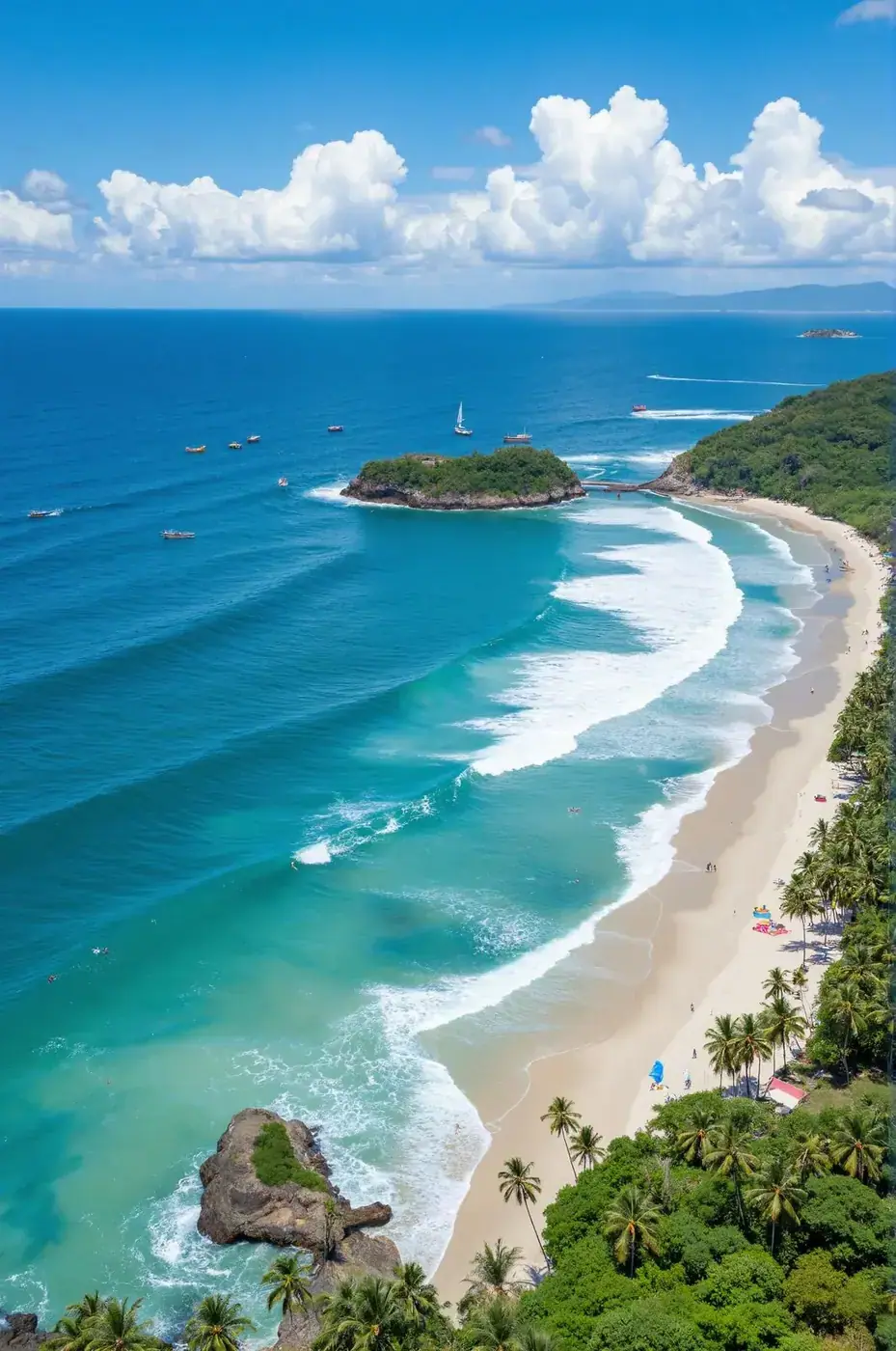
Pick Vietnam if you’re on a mid-range budget, want to cover serious ground (Hanoi to Ho Chi Minh City in 14 days), or care more about food and culture than polished beach infrastructure. Pick Thailand if you’re visiting Asia for the first time, want zero visa prep, or prefer well-organized resort beaches and strong tourist infrastructure. I’ve spent nine years in Southeast Asia and helped hundreds of travelers decide between these two — here’s the honest breakdown.
| Vietnam | Thailand | |
|---|---|---|
| Visa (Russians) | 45 days visa-free (e-visa ~$25 only if you stay longer) | 60 days visa-free today, reverting to 30 |
| 2-week budget/person | $900–$1,400 | $1,150–$1,700 |
| Mid-range hotel/night | $15–$30 | $45–$63 |
| Flight from Moscow | ~8h 40m to Hanoi | ~9h 36m to Bangkok |
| Best beach season | Feb–May (central), Dec–Mar (Phu Quoc) | Dec–Feb (Andaman coast) |
| Classic 2-week route | Hanoi → Ha Long → Hoi An → HCMC | Bangkok → Chiang Mai → Phuket |
| Food price (street meal) | $1–3 | $2–5 |
Vietnam in 2026: what a 2-week holiday looks like
Vietnam rewards travelers who move. The classic north-to-south route packs remarkable variety into 14 days: the chaotic energy of Hanoi’s Old Quarter, the otherworldly karst landscape of Ha Long Bay, the lantern-lit ancient town of Hoi An, and the modern buzz of Ho Chi Minh City. Each city feels like a different country.
Costs are genuinely lower. A decent guesthouse or budget hotel runs $15-30 per night in most cities. A bowl of pho on the street costs $1-2. A three-course meal at a mid-range restaurant is $8-15. Internal transport is cheap — the overnight sleeper bus from Hanoi to Da Nang (about 12 hours) costs $15-20, and the train between Da Nang and Ho Chi Minh City is roughly the same. If you want to cover the whole country, one domestic flight (for example Da Nang to HCMC) runs $30-60 booked a week ahead.
The visa is the one friction point. Vietnam requires an e-visa for most nationalities including Russians. Apply at evisa.gov.vn — check the current fee and processing time directly on the site. Allow 3-5 business days. The visa allows 90-day stays, which is generous for a 2-week trip.
Good for: travelers who want to see a lot in 2 weeks, food lovers, culture travelers, budget-focused visitors, those happy to DIY logistics.
Thailand in 2026: what a 2-week holiday looks like
Thailand has the edge on tourist infrastructure. Bangkok has a functioning metro (BTS/MRT), which makes navigating the city easy. Chiang Mai in the north offers temples, Thai cooking classes, and mountain scenery. The south — Phuket, Krabi, Koh Samui — delivers the palm-fringed, turquoise-water beaches that fill travel brochures.
Russian citizens currently enter Thailand visa-free for 60 days — no forms, no fees, no waiting. That 60-day stamp comes from a unilateral Thai scheme in force since 15 July 2024, and it is on its way out: the Thai cabinet has approved a return to 30 days, effective 15 days after publication in the Royal Gazette, which had not happened as of early August 2026. The 2005 Russia–Thailand bilateral agreement guarantees 30 days, so anything longer than a month should be planned around 30 days plus the 1,900 THB extension. Land crossings are capped at two visa-free entries per calendar year. Just a passport valid for at least 6 months. Thai authorities recommend having evidence of at least 10,000 THB ($280) in accessible funds, though this is rarely checked for tourists.
Hotels cost more. A 3-star hotel in Bangkok or Phuket runs $45-63 per night, with 4-star properties at $86-112. Street food is slightly pricier than Vietnam ($2-5 per meal), though still affordable by European standards. The main cost driver is accommodation — plan on spending $500-700 just on hotels for 2 weeks at a mid-range level.
Good for: first-time Asia visitors, travelers who want zero visa hassle, beach-focused holidays December through February, those preferring established tourist infrastructure.
Vietnam vs Thailand on a budget: where your money goes further
Vietnam costs 30-40% less than Thailand for a comparable mid-range 2-week trip. The biggest difference is accommodation: $15-30/night in Vietnam versus $45-63/night in Thailand. Over 14 nights, that gap alone is $420-$462. Food and transport are also meaningfully cheaper in Vietnam — street meals at $1-3 versus $2-5 in Thailand, and internal transport that’s consistently lower.
A realistic 2-week mid-range budget (excluding international flights):
- Vietnam: $644-$1,078 for accommodation + food + transport + activities
- Thailand: $1,064-$1,540 for the same categories
Both are cheap compared to Europe, but if you’re traveling on a tight budget or planning an extended trip, Vietnam stretches your money significantly further. For a 2-week vacation with a mix of culture and beach, Vietnam delivers comparable experiences for 30% less.
Check out our breakdown of Vietnam tour packages in 2026 if you want to understand what’s typically included versus DIY costs, or browse our own Vietnam tour catalog for ready-made pricing instead of doing the DIY math.
Beaches: season, water quality, and what to expect

Thailand’s beaches (Phuket, Krabi, Koh Samui) are at their best December through February — clear water, calm Andaman Sea, consistent sunshine. The water temperature stays around 27-29°C year-round. Infrastructure is polished: beach chairs, snorkeling tours, longtail boats are all well-organized. The trade-off: high-season crowds and premium pricing (30-60% higher than the May-July budget season).
Vietnam’s beaches are more varied in timing. The central coast — Da Nang, Hoi An, and Nha Trang — is excellent February through May, with warm weather and low rain before the summer monsoon hits. Phu Quoc island in the far south is best December through March. Ha Long Bay cruises are most comfortable in March-April and October-November (avoid summer typhoon season ). Vietnam’s beaches are less manicured than Thailand’s, but Nha Trang’s bay and Phu Quoc’s Long Beach genuinely compete.
Practical verdict: If your trip falls December-February and beaches are the priority, Thailand wins on consistency. If you’re going February-May or want a combination of culture and beach, Vietnam’s central coast makes more sense — and costs 40-50% less for a comparable beachfront hotel.
Timing the central coast right — and not landing in Nha Trang during jellyfish season — is exactly the kind of thing that trips people up. This is where I usually get involved: I build private itineraries with every stop and cost written out, then sort the hotels, transfers, and a local guide on the ground. Tell me your travel dates on Telegram and I’ll map the 14 days around them.
The best 14-day itinerary for each country
Vietnam — classic north-to-south (14 days):
- Days 1-3: Hanoi (Old Quarter, Ho Chi Minh Mausoleum, Temple of Literature, street food tour)
- Days 4-5: Ha Long Bay or Ninh Binh (overnight cruise or countryside cycling — book a reputable operator early, this fills fast March-April)
- Days 6-8: Hoi An (ancient town, Da Nang beaches, tailoring — build in 3 nights minimum)
- Days 9-11: Ho Chi Minh City (War Remnants Museum, Ben Thanh Market, Cu Chi Tunnels day trip)
- Days 12-14: Phu Quoc or Nha Trang (beach recovery before flying home)
For a detailed day-by-day version, see Vietnam’s best 7, 10 and 14-day routes . If you’d rather not stitch that route together yourself, our 15-day Vietnam tour already covers this exact north-to-south path with the hotels and transfers handled.
Thailand — Bangkok-north-south (14 days):
- Days 1-3: Bangkok (Grand Palace, Wat Pho, BTS Metro, weekend markets, Chao Phraya boat)
- Days 4-7: Chiang Mai (temples, Thai cooking class, Doi Inthanon national park, night market)
- Days 8-14: Phuket or Krabi (Patong Beach, Phi Phi island day trip, Phang Nga Bay, kayaking)
Both routes work comfortably in 14 days without feeling rushed. Vietnam requires one domestic flight or one overnight bus; Thailand requires one internal flight (Bangkok to Chiang Mai, $30-50) plus one more south.
How to choose between Vietnam and Thailand in 2026
Choose Vietnam if:
- Budget is a priority — you’ll spend 30-40% less for a comparable experience
- You want to cover a lot of ground: north-south diversity in 14 days
- Food is a major motivation (pho, banh mi, bun cha — one of the world’s great street-food scenes)
- You’re going February-May (central coast peak season)
- You’ve already done Thailand and want something new
Choose Thailand if:
- It’s your first time in Asia and you want easier logistics
- Visa simplicity matters — no forms, no fees, no waiting
- Beaches December-February are the priority
- You prefer established resort infrastructure and English widely spoken
- You have exactly 2 weeks and want predictable organized experiences
Both countries on a combined trip? Only if you have 4+ weeks. Two weeks for both means 4-5 days each, which is enough to see highlights but not enough to feel either country. Most travelers who’ve done both say they wished they’d spent more time in Vietnam.
For more context on what Vietnam offers long-term (if you’re considering more than 2 weeks), see our guide to the top 15 places to visit in Vietnam in 2026 .
Frequently asked questions
Is Vietnam or Thailand cheaper for a 2-week holiday? Vietnam is 30-40% cheaper overall. A mid-range 2-week trip costs $900-1,400 per person in Vietnam versus $1,150-1,700 in Thailand. The biggest gap is accommodation: $15-30/night in Vietnam versus $45-63/night in Thailand.
Do Russians need a visa for Thailand in 2026? No, not for either country. Russian citizens currently get 60 days visa-free in Thailand under the Thai scheme in force since 15 July 2024 — but the Thai cabinet has already approved a rollback to 30 days, which takes effect 15 days after publication in the Royal Gazette (not published as of early August 2026). The underlying 2005 bilateral agreement grants 30 days, so plan long trips around 30. Vietnam gives Russians 45 days visa-free under resolution 44/NQ-CP, valid to 14 March 2028; the $25 e-visa at evisa.gov.vn is only needed beyond 45 days.
What is the best time to visit Vietnam or Thailand? Both peak December through February. Vietnam’s central coast (Da Nang, Hoi An, Nha Trang) is excellent February to May. Phu Quoc is best December to March. Thailand’s Andaman coast (Phuket, Krabi) is ideal December through February.
How long is the flight from Moscow to Bangkok or Hanoi? Moscow to Bangkok Suvarnabhumi is about 9 hours 36 minutes direct. Moscow to Hanoi is approximately 8 hours 40 minutes. Ho Chi Minh City is slightly further at around 9 hours 52 minutes.
Which has better beaches: Vietnam or Thailand? Thailand has more developed resort infrastructure and consistently calm Andaman Sea water in winter. Vietnam’s beaches — Nha Trang, Phu Quoc, Da Nang — are less crowded, 40-50% cheaper for comparable hotels, and the central coast has a longer usable season (February to May).
Can I do both Vietnam and Thailand in 2 weeks? Technically yes, but you’d see neither country properly — about 4-5 days each with significant transit time in between. Pick one for this trip.
Planning a Vietnam holiday in 2026?
Vietnam Samurai Tour organizes multi-day tours across Vietnam — custom north-south itineraries, beach add-ons, off-the-beaten-path options, and group tours from Da Nang. Our team lives here and knows what actually works in 14 days.
- Telegram @vietnam_samurai — message me directly, I’ll help plan your route