
In Vietnam in 2026, spend 183+ days in a calendar year and you’re a tax resident, paying progressive income tax from 5% up to 35% above 80 million VND a month. I learned this the hard way in Da Nang: eleven months in, I got a 3 million VND fine for never registering with the tax office.
After that I figured out the Vietnamese tax system properly and put the whole thing in one place. Here’s what any foreigner working or living in Vietnam needs to know in 2026.

Tax resident or non-resident — the main question
This determines your rate. The rule is simple: spend 183+ days in Vietnam in a calendar year, or 12 consecutive months from your first entry, and you’re a tax resident. Second criterion — a permanent residence plus a rental contract for 183+ days. Either one is enough.
Residents pay progressive personal income tax on worldwide income. Non-residents pay only on Vietnamese-sourced income but at a flat 20%.
In practice: live here just over half the year and work for a local employer → resident. Fly in for three months to enjoy the country, no Vietnamese income → non-resident, no return to file.

For people counting the 183 days across visa runs, see our first visa run experience — covers how the days add up across border crossings.
Progressive income tax brackets for residents
Seven brackets, calculated on monthly taxable income. First 5 million VND — 5%. Then 10%, 15%, 20%, 25%, 30%. Anything above 80 million VND per month — 35%.
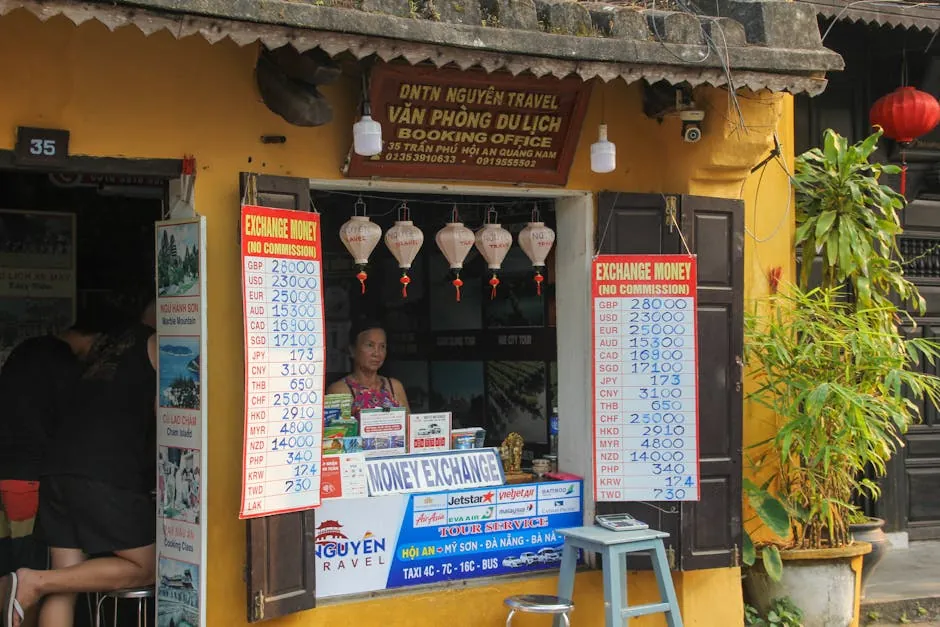
At 2026 exchange rates, 80 million VND is roughly $3,200. So the top 35% bracket kicks in for anyone earning a bit over $3,000 per month after deductions. For an expat on an international company salary, that’s an easy bracket to land in.
This is the rate on taxable base, not gross salary. Before applying the brackets, the standard personal deduction and any dependent deductions come off your income — more on those next.
How to get a tax code (MST) as a foreigner
The Vietnamese tax code is called MST (Mã Số Thuế). It’s a 10-digit number, and you can’t legally work without one. If you’re employed by a local company, the employer files for your MST in the first 10 days after the contract is signed. From you they need: passport copy, visa or TRC, and a form.
If you’re freelancing or running a business, you go to the district tax office in your registered area yourself. You’ll need: passport, a Vietnamese address (rental contract or address on TRC), and form 05-ĐK-TCT. The MST is issued on the spot — about an hour with the queue.

Keep your MST card handy — banks ask for it when opening accounts, notaries want it, and so do long-term vehicle leases. If you’re still working out a long-stay visa, start with the 2026 e-visa guide — without a 90+ day visa, getting an MST doesn’t make much sense.
Deductions that actually reduce your tax
A resident deducts the following from income before applying the brackets:
- 11 million VND/month for yourself — standard personal deduction
- 4.4 million VND/month per dependent (non-working spouse, minor child, elderly parents)
- mandatory contributions to social and health insurance
- donations to registered charities
In practice: if your salary is 40 million VND, your spouse doesn’t work, plus one child — only 40 − 11 − 4.4 − 4.4 = 20.2 million is taxable. That’s a totally different tax burden.

Dependents need documentation: marriage certificate, child’s birth certificate. Most foreigners apostille these in their home country, then get a translation into Vietnamese done at a licensed notary in Da Nang or Ho Chi Minh City. Budget 2-3 weeks and 3-5 million VND for that.
Double-taxation treaties
Important if you pay taxes in another country on remote work, or earn income in two countries. Vietnam has double-taxation agreements with most major countries (US, UK, Australia, EU members, Russia, etc.). Under those treaties, the same income isn’t taxed twice: the source country has priority and the other one credits what was already paid.
For someone working for an employer back home and living in Vietnam more than 183 days, that means: you become a Vietnamese tax resident and have to declare worldwide income here. But tax already paid abroad is credited. To get the credit you’ll need a certificate from your home country’s tax authority showing what was paid, translated and notarized.
If you’re coming from Russia: since 2024 Russia tightened the non-resident status (30% rate), so a lot of people moving over deliberately establish Vietnamese residency, where the brackets sit lower up to the high end. Official Vietnamese tax info is on the General Department of Taxation site gdt.gov.vn .
When and how to file
The annual return (Form 02/QTT-TNCN for residents) is due by 31 March of the following year. If you work for a local company, they file it and you just sign. Multiple income sources or freelance — you file yourself, either through the gdt.gov.vn portal or in person at your district tax office.

Late filing penalty — minimum 2 million VND plus 0.05% per day on the unpaid amount. Deliberate concealment — up to 25 million and possible criminal exposure. Mine cost me 3 million VND and a lot of nerves. Won’t be making that mistake twice.
Vietnam tax for foreigners isn’t a scary topic if you sort it out in your first month here. The worst thing you can do is pretend the problem doesn’t exist and get a letter from the tax office in year two. It’s one small piece of the bigger picture - the rest of what we cover on life and travel in Vietnam lives at vietnam-tour-guide.com .
Need help with tax, visa or residency?
If you’ve been in Vietnam more than six months, or you’re planning the move and can’t figure out how to set tax up — message us:
- Instagram @vietnam_samurai — message me for route and life-in-Vietnam questions
- Telegram — for visa, residency and relocation questions