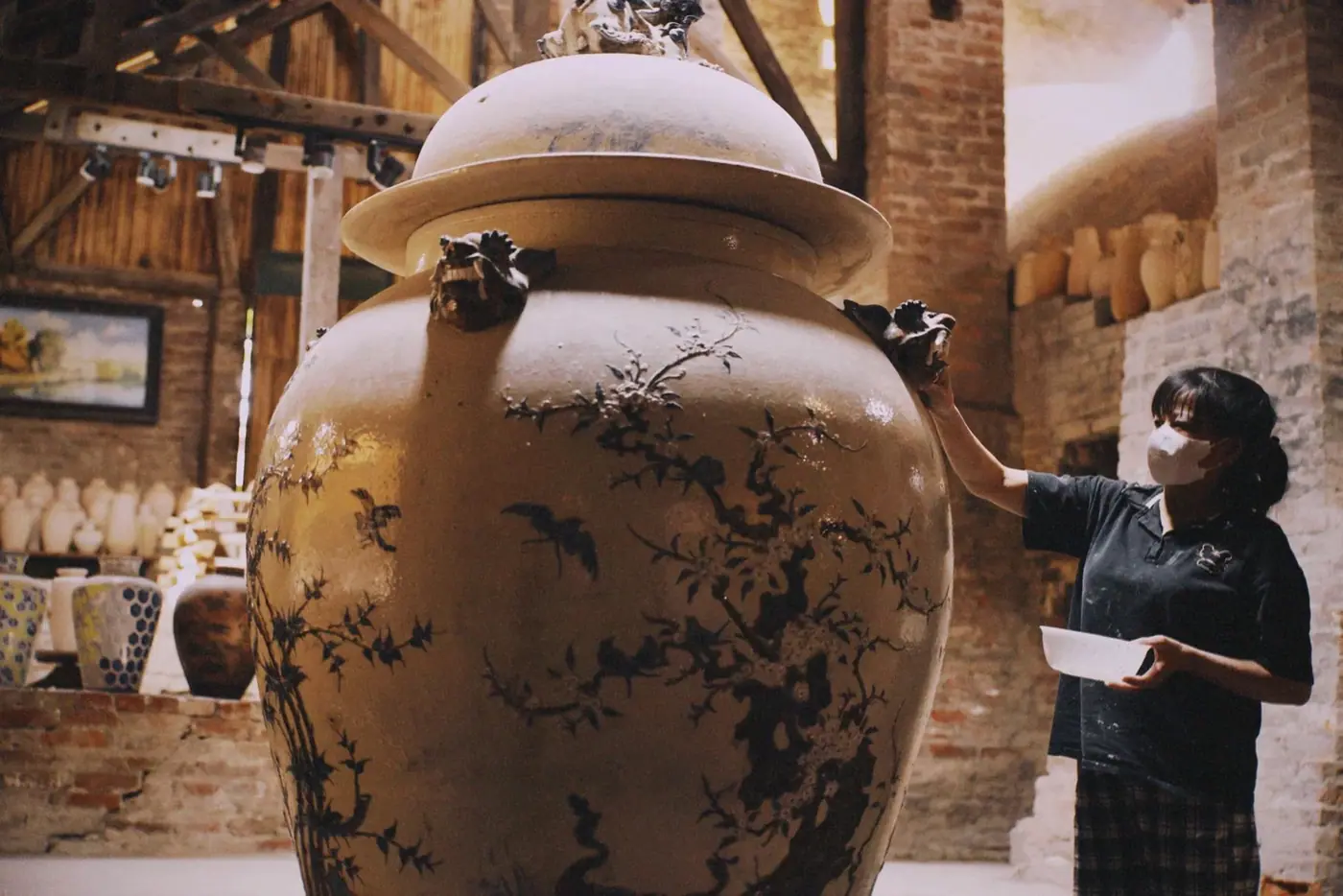
Bat Trang is a working pottery village on the eastern bank of the Red River in Hanoi’s Gia Lam district, and it is close enough to reach in half a day without joining a big bus tour. The village sits about 13 kilometers from central Hanoi, a taxi ride of roughly 30 to 45 minutes. Villagers have been throwing pots here for close to 1,000 years, and you can still watch them work in family kilns down the narrow alleys behind the main market.
I’ve spent years living in Hanoi and running day trips across northern Vietnam, and Bat Trang is one of the outings I point visitors toward most often when they want something real instead of a bus-park photo stop. If you’re still mapping out your first two days in Hanoi , Bat Trang slots in easily as a half-day add-on rather than a separate trip.
What Is Bat Trang Village?
Bat Trang has produced ceramics for close to 1,000 years, and the village still runs on family workshops rather than one central factory. It sits on the Red River in Gia Lam district, about 13 kilometers from central Hanoi, and the name comes from the bowls, or bat, that were fired here for generations. The Bat Trang Communal House, known locally as Dinh Bat Trang, anchors the older part of the village and is worth a five-minute stop for the architecture and local history before you head into the market.

Most first-time visitors head straight for the shops, but the village itself is small enough to walk in under an hour. The main market sits close to the river, and the family kilns and workshops fan out into the alleys behind it, which is where the more interesting parts of a visit tend to happen.
How Do You Get to Bat Trang from Hanoi?
Three practical options get you to Bat Trang from central Hanoi in 2026. A taxi or Grab takes 30 to 45 minutes and costs roughly $5-8 (120,000-200,000 VND) one way, though this is not a fixed fare and depends on traffic and the driver you get. Public bus route 47A leaves from Long Bien Bus Station, takes about 30 minutes each way, and a round trip fare runs around $0.60 (14,000 VND) total, making it the cheapest option by a wide margin.

On weekends, a Red River boat tour departs from Chuong Duong Do wharf, known locally as pier 42, and combines Bat Trang with the Dam and Dai Lo villages plus a stop at the Chu Dong Tu temples. This is a full-day package built around several riverside stops, not a simple ferry crossing, and tour operators price it at roughly $14-16 (350,000-400,000 VND) per person.
What Does a Visit Cost?
Expect to spend somewhere between $2 and $10 depending on how much you do once you arrive. The Bat Trang Ceramic Museum, officially the Vietnam Village Pottery Quintessence Center, charges an entry fee that sources put at $2-2.50 (50,000-60,000 VND), though the figure is reported inconsistently across sites, so budget toward the higher end. A combo ticket bundling museum entry with a pottery workshop runs about $8 (198,000 VND).

Opening hours are another point where sources disagree. General travel guides list the museum as open daily from 8 a.m. to 6 p.m., but the museum’s own site states it operates Monday through Friday from 8 a.m. to 5:30 p.m. only. Check current hours before building a weekend visit around it. A stand-alone pottery wheel session costs roughly $2-3 (50,000-70,000 VND) for adults and about $2 (50,000 VND) for children, though longer sessions with a finished piece to take home can run notably higher.
What Is There to Do Besides Shopping?
Beyond the museum and the market stalls, the most memorable part of a Bat Trang visit is usually the narrow alleys behind the main road, where family kilns fire pieces in full view of the street. Authentic Bat Trang, a family-run workshop with locations at 115 Hang Gai in Hanoi’s Old Quarter and inside the village itself, is well reviewed on TripAdvisor and lets visitors try the wheel alongside working potters rather than in a roped-off tourist setup.

Walking the alleys costs nothing and takes about 30 to 40 minutes if you stop to watch a few artisans at work. This is also where the Bat Trang Communal House sits, giving the visit a sense of the village’s history rather than just its shopping. If hands-on craft is what you’re after, it pairs well with the cooking classes in Hoi An, Hanoi, and Saigon that run on a similar half-day format.
How Can You Tell Handmade Pottery from Mass-Produced?
Handmade Bat Trang pieces tend to be slightly uneven, with brush strokes that vary from piece to piece and a body that feels thicker and heavier in the hand than what you would find in a regular home goods shop. The glaze on genuine village work has a faintly ivory, slightly opaque quality, and the classic Bat Trang colors are moss green, crackled blue, and grayish-brown. Mass-produced pieces are almost too symmetrical, with a thinner glaze that chips or fades faster over time.
Most stalls in the main market sell everyday bowls, cups, and flower pots made in bulk, not the fine art pieces that built the village’s reputation, and figuring out which workshop actually makes what it sells is the part most visitors struggle with. On the trips I run out of Hanoi, I take clients straight to the family kilns I know produce their own work rather than resell factory stock, and I build in enough time at each stop that nobody feels rushed into buying something they haven’t really looked at. What I need from a traveler is just a sense of how much shopping time they want versus workshop time, and I plan the stops around that.
When Is the Best Time to Visit?
The best time to visit Bat Trang is a weekday morning around 7 to 8 a.m., when artisans are actively working the wheels and the market has not filled up with weekend day-trippers from Hanoi. Vietnam’s dry season, roughly October through April, is also the more comfortable stretch weather-wise, without the heat and humidity that build by midday in the wet months.
Weekend mornings work too, and they are the only time the Red River boat tour runs from Chuong Duong Do wharf, so if that route interests you, a weekend is the only option. The trade-off is a busier market and more visitors competing for the same photo spots in the alleys.
How to Visit Bat Trang, Step by Step
A first Bat Trang trip from central Hanoi breaks down into five stops.
- Get to the village by taxi or Grab, by bus route 47A from Long Bien Bus Station, or by the weekend Red River boat tour from Chuong Duong Do wharf.
- Start at the Bat Trang Communal House or head straight into the alleys behind the market while it is still cool and the kilns are active.
- Visit the Bat Trang Ceramic Museum, checking current opening hours before you go since travel guides and the museum’s own site do not fully agree.
- Book a hands-on pottery wheel session, either through the museum’s combo package or at a family workshop such as Authentic Bat Trang.
- Walk the Bat Trang Ceramic Market last, once you have a sense of what handmade work looks like, and negotiate at the stalls that sell it.
What Mistakes Do First-Time Visitors Make?
The most common mistake is assuming everything in the Bat Trang market is handmade simply because it was bought in the pottery village. Most stalls sell mass-produced daily-use ceramics, and travelers who want an authentic piece need to seek out a specific workshop or family kiln instead. A second mistake is showing up at midday on a weekend, when the alleys are hot and crowded and the artisans you came to see have often stepped back from the wheel.
A third mistake is treating the museum’s listed hours as fixed. Because travel-guide sources and the museum’s own site disagree on closing time, arriving late in the afternoon without checking first can mean finding the doors already shut.
Half-Day or Full Day: How to Decide
A half-day trip covers the essentials: the market, one workshop, and a walk through the family kiln alleys, and it fits into an afternoon without disrupting the rest of a Hanoi visit. A fuller itinerary that adds the ceramic museum, a workshop, market browsing, and lunch in the village runs closer to 5.5 hours. Pick the half-day version if Bat Trang is one stop among several, and the full version if it is your main outing for the day.
Bat Trang shows up as a stop on several of our multi-day Vietnam routes , including a 15-day route across the north, center and south , for travelers who want it folded into a longer trip instead of a standalone afternoon.
If you would rather skip the planning and go straight to the parts of Bat Trang worth your time, message me on Telegram and tell me your dates.
Frequently asked questions
Is Bat Trang worth visiting if I only have a few days in Hanoi? Yes, mainly because it takes half a day rather than a full one. A taxi gets you there in 30 to 45 minutes, and the core experience of the market, alleys, and a workshop session fits into a single afternoon without eating into time for the Old Quarter or Hoan Kiem Lake.
Can I visit Bat Trang with young kids? The pottery wheel workshops are set up for children, with sessions priced around $2 (50,000 VND) for kids, and the hands-on nature of shaping clay tends to hold their attention better than a straight walking tour would. The market alleys are uneven in places, so a stroller is impractical, but a child who can walk handles the visit fine.
What happens if it rains during my visit? The Bat Trang Ceramic Museum and most family workshops are indoors, so a rainy day still leaves you with the museum, a covered workshop session, and parts of the market under awnings. The open-air alleys and communal house grounds are the only parts that become uncomfortable in heavy rain.
Should I bargain at the pottery market? Bargaining is normal at the general market stalls selling everyday bowls, cups, and flower pots, since prices there are not fixed. Workshops and family kilns selling their own handmade pieces are less flexible, since the pricing reflects the time and skill in a specific piece rather than bulk production cost.
Do I need cash, or can I pay by card? Cash is the more reliable option across the market stalls and smaller family workshops, and Vietnamese dong is the practical currency to carry even though prices in this guide are converted to dollars for reference. Larger operations like the ceramic museum’s combo ticket counter are more likely to accept cards, but do not count on it village-wide.
Can I combine Bat Trang with another day trip from Hanoi? The weekend Red River boat tour from Chuong Duong Do wharf already combines Bat Trang with the Dam and Dai Lo villages and the Chu Dong Tu temples as a single full-day package. Outside of that boat route, most visitors treat Bat Trang as a standalone half-day trip rather than stacking it with a separate destination on the same day.